
I Personified a Toy Dinosaur Named Scar for Two Years, and I Know You Relate: On the Guilt of Play
Moms, parents– we are in unique times for parenting (and absolute global chaos?). Let’s talk guilt, ‘good’ parenting, play, and what has happened in the modern west*.
If you are a parent, you know the pressure to play. AND IT’S HUGE. How often do you feel like a terrible parent with your kid pulling at your jeans begging you to play? Over and over and over. And if you are like me, playing is HARD. I cannot play for more than 5 minutes without feeling like my brain is dissolving. As much as I try to enjoy it, and would love to, it is HARD.
While ‘play’ is seen cross-culturally in parent-child engagement, the way “we” play, is notably different. And actually, this has been a high driver in the increase in our experiences of mom/parent-guilt.
Across cultures and history, this type of regular parent-child play is not universal. Instead, many other cultures have created worlds where children’s ‘play’ is part of daily life and tasks that need to be done. Children learn to participate in real life activities, and play is less constructed or separated. They then learn by imitation and practice. Through this, they develop skills, esteem and independence.
What we see in the west is a largely separated children’s world, as opposed to incorporating children into the adult social world. We are likely to see trampoline parks, play-dates, and activities specifically for children, outside of the adult world, right? We pause entire days and schedules to orient around separated play.
Smaller scale societies and other cultures across the globe see much more play between children. This is the expectation. Parents are adjacent and may interact playfully, but there is much less “playing with” your child. Play is peer directed, not organized into time quadrants and planned play-date drop-offs.
The idea that “good” parents plays with their kids is definitely new. If you are an elder-millennial like me, or older– I would be willing to bet your parents didn’t often get down on the floor and play with you. Maybe on occasion, but it was less likely to be an expected default. We were out in the neighborhood with our friends, largely unsupervised (for better or worse!).
Why Parent-Child Play Increased in the West
So why this and where did it come from? And why is it helpful to know? (I wish just knowing this would directly fix your guilt about struggling to play, but sadly, mom/parent-guilt is a monster.)
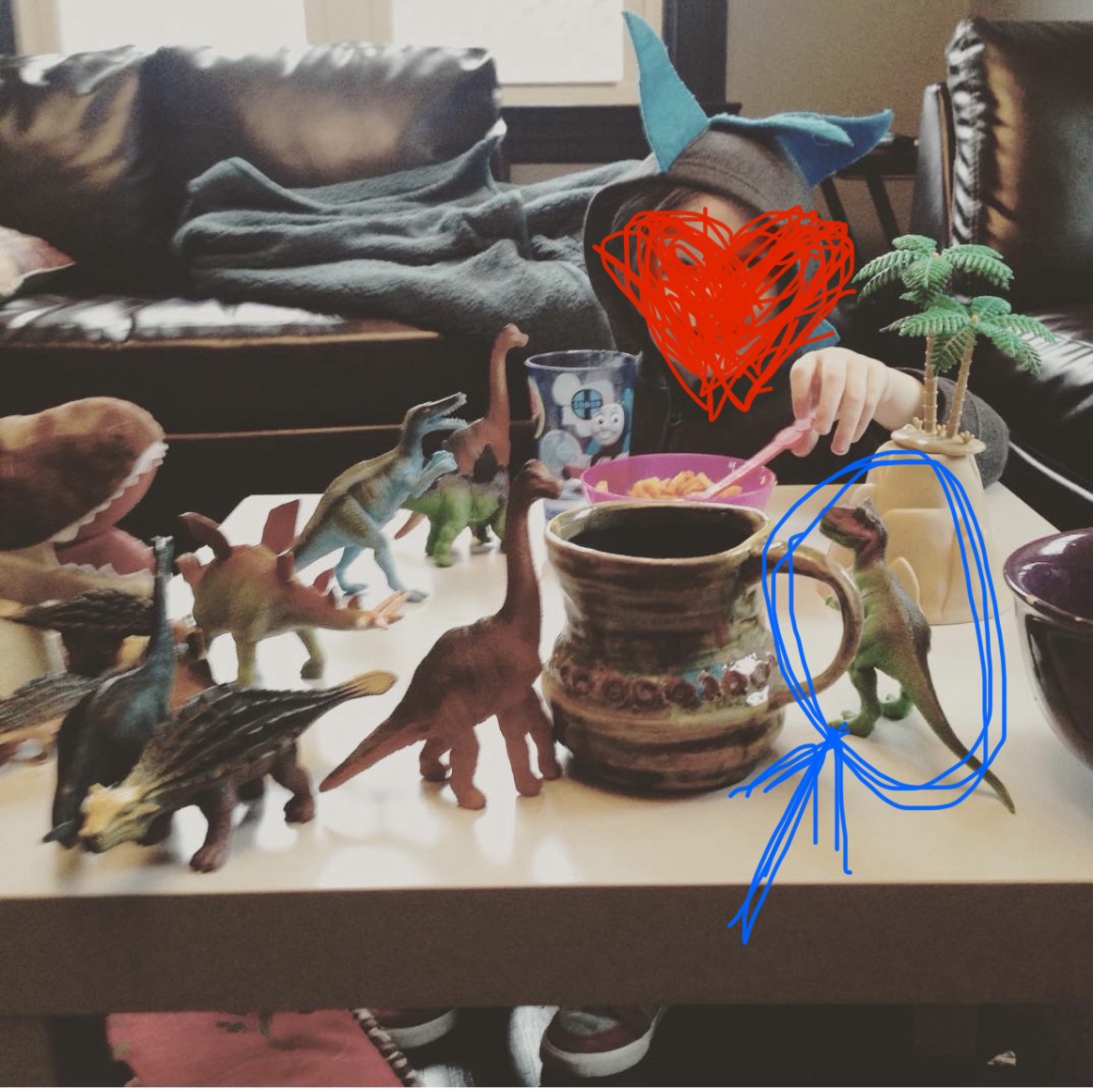
I studied these things and I still spent 40 percent of my now-teenage son’s toddler years personifying a small dinosaur figurine named Scar. I was Scar while I sipped my coffee in the morning and begrudgingly while I cooked dinner. Per my son’s request at the time, Scar talked a lot, and Scar ALWAYS wanted to play. It was so much pressure, people– you can’t break character. Saying no to playing felt awful, like a rejection of my child. And so, I was Scar. God, sometimes, my inner-voice is still Scar.
But let’s do some Fact Checking, eh? Here’s why playing with your children has skyrocketed to an expected ‘norm’ in the west.
Attachment theory boomed in Psychology starting in the 1940’s. Attachment Theory is absolutely valid and important, and it has led to important aspects of healthy parenting and child-centered parenting. It also honed in on the importance of quality time. In the west, we have taken quality time and run with a number of inaccurate assumptions about what that means. We have made it separate, constructed, and child-focused–and often layered with guilt-laden intensive parenting (also new!).
Actually, healthy attachment is about responsiveness and availability to your child. It supports shared interaction and being a secure base for kids to explore. This responsiveness can be playful or encouraging of play, of course! But cross-cultural and Anthropological research shows that healthy attachment in no way requires the constant parent-child play the west has adopted.
Intensive Parenting grew from the research on child development, and our great fear of totally messing up our kids. Makes sense, right? But intensive parenting has propelled the idea that playing with your child is the key way to connect with them and is necessary to attachment and mental health. And this is not totally accurate.

“Intensive parenting methods have propelled the idea that playing with your child is the key way to connect with them and is necessary to attachment and being a “good parent”. And this is not totally accurate.”
How High Expectations of Parent-Child Play has Impacted the West:
If you are unfamiliar, intensive parenting is a lot of what we are seeing in modern parenting, and refers to all aspects of daily life revolving around the child, constant stimulation and expert-backed growth, and constant involvement and redirection. Actually, the extreme of these has been shown to increase anxiety, hinder independence, self-esteem and resilience in kids. Some kids then struggle to play with other children, or understand child-child dynamics in play.
And for parents? This has created a very real culture-specific anxiety for parents, who constantly feel like if they don’t ‘play’ enough, they might not be meeting their kid’s needs. It has also reduced parental confidence. Interestingly, in the west, we are more likely to assume we aren’t spending quality time with our kids if we aren’t ‘playing’ with them. But this is not true!
While I could write a dissertation on this, I know you only have like 2 minutes before your kid wakes up, and your attention span is already frazzled. Relatable. So I will keep it brief.
Play is universal. It’s how kids learn!

(Photo: From my time in Haiti, kids helped out in free time by picking up trash around the village. They then used that trash to make toys and tools, all on their own and of their own ideas and creativity. This is a pull-car!)
What we see cross-culturally: children’s play is fairly autonomous, with other children or within the scope of the necessary to-do’s of learning and living. Play is how the children learn to do the skills they develop alongside adults.
What we see in the west*: How adults interact in and direct children’s play is different, and child-adult play has become a primary type of parenting. We have created separate, external things to cater specifically to the child, as opposed to incorporating the child into what is already happening in the day-to-day.
Also notable? We are less likely to live in community-oriented environments, and our tendency toward isolation and independence (you know, the Village we are all seeking) increases the pressures on parents to be the playmate too. Our guilt is a huge driver.
So Should I Play with My Kid?
You are doing amazing. I know this, because you care enough to learn about the topic. You clicked the link!
Playing does not have to be the main way to connect with and develop attachment and relationship with your children. Can you be playful, or play sometimes? Of course! But adult-child play doesn’t need to be constructed or a completely separated activity for a healthy attachment and relationship to form, or for a child to learn. It does not equate to good parenting.
For example, working with your kid to make cookies, or clean a kitchen or go to the grocery store is just as connective. This can incorporate just as much play, and teach life skills! Such is to say, life is so busy and hard. You are doing enough and showing up to teach your kid about the world, even if you can’t personify dragons or pretend to be a monster truck.
TLDR: So, play is great, and isn’t the issue. It’s our involvement and assessment of our part in it, driven by anxiety and guilt associated with attachment parenting and child-centered studies, which have increased our liklihood to feel that playing with our children ensures connection, ‘good’ parenting and healthy attachment. Healthy attachment is empathetic responsiveness and availability. Good parenting does not mean constantly playing with and entertaining your child, and can ultimately lead to increased stress in both kids and their parents. So breathe, you are doing enough!
If you are interested in the topic, Michaeleen Doucleff’s Hunt, Gather, Parent is a highly recommended read!
Do you struggle to play with your kid? Do you feel guilt and pressure to play? You aren’t alone!

Sources:
*This mostly pertains to middle-class America
Doucleff, Michaeleen. Hunt, Gather, Parent: What Ancient Cultures Can Teach Us About the Lost Art of Raising Happy, Helpful Little Humans. New York: Avid Reader Press, 2021.
Egami S. Impact of “intensive parenting attitude” on children’s social competence via maternal parenting behavior. Front Psychol. 2024 May 3;15:1337531. doi: 10.3389/fpsyg.2024.1337531. PMID: 38765832; PMCID: PMC11100988.
Lancy, D. F. (1996). Playing on the mother-ground: Cultural routines for children’s development. Guilford Press.
Ochs, E., & Izquierdo, C. (2009). Responsibility in childhood: Three developmental trajectories. Ethos, 37(4), 391–413.
Rogoff, B. (2003). The cultural nature of human development. Oxford University Press.
Rogoff, B., Sellers, M. J., Pirrotta, S., Fox, N., & White, S. H. (1975). Age of assignment of roles and responsibilities to children: A cross-cultural survey. Human Development, 18(5), 353–369.
Weisner, T. S. (2002). Ecocultural understanding of children’s developmental pathways. Human Development, 45(4), 275–281.
Weisner, T. S. (2020). Still the most important influence on human development: Culture, context, and methods pluralism. Human Development, 64(4–6), 238–244.
Whiting, J. W. M., & Whiting, B. B. (1975). Children of six cultures: A psychocultural analysis. Harvard University Press.
Coppens, A. D., Alcalá, L., Rogoff, B., & Mejía-Arauz, R. (2016). Children’s contributions in family work: Two cultural paradigms. In Families, intergenerationality, and peer group relations. Springer.
Worthman, C., Plotsky, P., Schechter, D., & Cummings, C. (Eds.). (2010). Formative experiences: The interaction of caregiving, culture, and developmental psychobiology. Cambridge University Press.
Lew-Levy, S. et al. (2017). “How Do Hunter-Gatherer Children Learn Subsistence Skills?” Human Nature.
Lancy, David F. (2007). “Accounting for Variability in Mother–Child Play.” American Anthropologist, 109(2), 273–284.
Gray, Peter (2011). “The Special Value of Children’s Age-Mixed Play.” American Journal of Play.
Lancy, David F. (2016). “Playing With Knives: The Socialization of Self-Initiated Learners.” Child Development, 87(3), 654–665.
No responses yet